For us, no meal is complete without a little something sweet. Whether you have a hankering for a sumptuous fruit salad or an elaborate cake, our desserts will satisfy the sweetest tooth.


To browse these recipes in a list format, along with all of our recipes by category, see our Full Recipe Listing.


Cherry Port Sauce

Posted on 17 August 2010 by The Gilded Fork

Sweet dark cherries simmered in ruby port wine with a hint of star anise and cinnamon is the ideal topping for a perfect ending dessert. Serve over ice cream, as a filling for éclairs, or a spread for cheesecake.

4 servings

Ingredients

1 cup ruby port
¾ cup sugar
1 lb fresh or frozen pitted cherries
1 cinnamon stick
¼ teaspoon ground star anise
5 teaspoons cornstarch
5 teaspoons water
1 teaspoon vanilla

Equipment

Small saucepan, cherry pitter (or paring knife), plastic gloves, plastic cutting board

Preparation

Prepare the cherries:
Pit the cherries using a cherry pitter or paring knife. To use a paring knife, cut around the circumference of the cherry, pull the halves apart and remove pit.

[Chef’s note: Cherry juice will stain. Use care when pitting the cherries by using plastic gloves, cutting boards and frequently wiping up juice spills on your counter.]

Make the sauce:
Combine the port wine and sugar in a small saucepan and bring to a boil. Add the cherries, cinnamon stick and star anise and simmer for 5–10 minutes until the mixture reduces and starts to become syrupy.

[Chef’s note: If using frozen cherries, you might need to simmer a bit longer to defrost the cherries and reduce the resulting water.]

Mix the cornstarch and water together to make a slurry, stirring until completely dissolved. Add the cornstarch slurry to the sauce and bring to boil. Reduce the heat, and continue to simmer until the mixture is thick and shiny. Remove from the heat and cool completely. Cover and chill until ready to serve.

Service

Serve over your favorite ice cream or creamy rice pudding. The sauce can also be spread over cheesecake.

Variations

For a great homemade Cherries Jubilee Ice Cream, bring a quart of good-quality vanilla bean ice cream to room temperature, mix the Cherry Port Sauce with the ice cream and place back into a freezer-safe container. Freeze 24 hours, then serve.

Recipe and photo by Lia Soscia

Tags: , ,

Comments (0)

Grilled Peaches with Coconut Milk and Cinnamon Sugar

Posted on 30 July 2010 by The Gilded Fork

This simple preparation for fresh fruit is a great way to utilize the grill for more than just charring meat!  The natural sugars in the fruit are enhanced by the cinnamon sugar, which caramelizes on the grill to create gorgeous, sweet grill marks.  Dress them up, or eat them as-is: either way these sweet peaches will sing a sweet song of summer!

Psst…This recipe is in our new Gilded Fork cookbook!

4 servings

Ingredients

4 ripe peaches, pitted and halved
1 14 oz. can coconut milk, unsweetened
1 teaspoon ground cinnamon
1½ cups sugar, course ground, if available
Mint sprigs, for garnish
Cinnamon or vanilla ice cream, if desired

[Chef’s Note: As peach season approaches, numerous varieties might be available. Within those myriad varieties exists a subdivision: freestone peaches. This simply means that their pit comes out easily when the peach is cut in half or when segments are removed. In the case of the non-freestones, the flesh could stubbornly stick to the pit. While there is no flavor difference, it may be easier to get perfect halves when using freestone peaches.]

Equipment

Outdoor grill or
Cast iron grill pan

Preparation

Heat a cast iron grill pan over medium high heat, or preheat an outdoor grill.

[Chef’s Note: If grilling with charcoal, the coals should be grey and ashy with no flame. As this is a dessert recipe, the coals should be past their hottest point after grilling the main course. When ready to grill, just scrape down the grill grate with a wire brush and lightly oil it.]

Clean and dry the peaches, and cut in half, removing the stones. Shake the coconut milk well to emulsify the liquid and then open the can, pouring it into a shallow, wide dish. Mix the sugar and cinnamon well, and pour into another shallow dish.

Dip the cut side of each peach half first in coconut milk, then in the sugar mixture, and shake off any excess sugar. Arrange the peaches on the hot grate and grill until nicely browned on both sides (longer on the flat side than then round side), about 15 minutes total. To create cross hatched grill marks, rotate the peach halves a little while still grilling on the cut side, after about 4-6 minutes.

Service

Transfer the peach halves to plates or a platter for serving and garnish with mint sprigs. Alternatively, you may serve them in bowls over ice cream, 2 halves per serving.

Variations

You may also use this sweet grilling technique for pineapple, bananas, plums, or nectarines. Cut the bananas in half like for a banana split, and take them off the grill sooner.

You may also use melted butter in place of the coconut milk, if desired.

Recipe by Mark Tafoya

Tags: , , ,

Comments (2)

Basil & Orange Ice Cream with Cinnamon Tuiles

Posted on 05 July 2010 by The Gilded Fork

It seems that any time we work with a vibrant, fresh, and seasonal flavor, we can’t seem to resist turning it into an ice cream or a sorbet.  Basil is one of those ethereal flavors that is magical when transported along the palate with the icy coolness of iced cream and just a tang of perfumed citrus on the after palate.  The cinnamon tuile is a classic recipe that makes this simple recipe utterly elegant, not to mention a perfect palate complement to the flavors of the ice cream.  To keep the ice cream light, we omitted the eggs and the traditional custard-style ice cream here, opting for a simple light cream infusion:  Summer flavors frozen in time!

Serves 8

Ingredients

3 cups heavy cream
1 vanilla bean pod, split
6 fresh large basil leaves, coarsely torn or chopped
Zest of ½ orange
2/3 cup sugar

Preparation

Place a large, heavy-bottomed saucepan over medium heat.  Combine the cream, vanilla, and basil to the pot.  Gently warm the cream over the heat, but do not let it come to a boil.  Remove the saucepan from the heat when the mixture is just coming to a simmer: you should see steam rising from the surface and small bubbles forming along the edges.  Add the sugar and the orange zest, and stir until combined.  Remove from the heat, set aside and allow the mixture to infuse while cooling to room temperature.

Optional: Strain into a clean container.  Cover and refrigerate for at least 2 hours until cold, or overnight.

Stir the chilled mixture and then freeze in an ice cream maker according to manufacturer’s directions.  Transfer ice cream to a container and freeze until solid, about 2 hours.  Remove to the refrigerator to “cure” about 20 minutes before serving.

Cinnamon Tuiles

Tuiles are thin, crisp cookies that are meant to imitate the shape of a French roof tile.  While the “classic” preparation is to drape the hot tuiles over a rolling pin to shape them, you can get adventurous and use underside of a muffin tin to form a cup.

Makes approx. 2 dozen (24) tuiles

Ingredients

4 tablespoons butter at room temperature
2 egg whites
½ cup flour
2/3 cup confectioners’ sugar
Scant 1 teaspoon cinnamon
1 teaspoon vanilla

Preparation

Preheat the oven to 350˚ F.  Line two cookie sheets with parchment paper.

In a medium bowl, combine the butter and egg whites with a whisk.  Whisk until smooth.  In a larger bowl, combine the flour, confectioners’ sugar, and cinnamon.  Add the wet ingredients to the dry and whisk until smooth.  Add the vanilla and whisk until well combined.

Using an offset spatula, drop one tablespoon of the batter onto the prepared cookie sheet and spread very thin to form about a 6” diameter circle.  The batter will look translucent in some spots.  Repeat spacing each tuile about 3” apart.

Bake each cookie sheet separately for about 6 to 8 minutes, until the edges are just beginning to brown.  Remove the cookies from the oven.  Working quickly, drape the hot cookies over a rolling pin or the side of an empty wine bottle, making sure they do not touch.  Once the cookies are firm, transfer to a wire cooling rack and cool completely.

Prepare the other cookie sheet for baking while the first is in the oven.  Repeat.  Make sure the cookie sheet is cool before spreading the next round of batter on it.

Recipe originally published in August 2005.

Recipe by Donna Marie Desfor
Photo: Kelly Cline

Tags: , , ,

Comments (0)

Tofu Panna Cotta with Blood Orange and Pistachios

Posted on 24 May 2010 by Chef Mark Tafoya


House Tofu Panna Cotta with Blood Orange and Pistachios

Serves 8

Ingredients

1 block House Foods soft tofu
1/2 cup honey
1 Tablespoon powdered gelatin
1 Tablespoon sugar
1 cup soy milk, room temperature
Pinch of salt
Zest of 1/2 blood orange, peeled into 1-inch wide strips
2 blood oranges
1 recipe blood orange syrup (recipe follows)
1 recipe candied pistachios (recipe follows)
Fresh mint and tarragon, fine chiffonade

Directions

Stir the powdered gelatin and sugar together. Place the soy milk in a small bowl and whisk in the sugar and gelatin, adding in a thin stream. Allow the gelatin to bloom for 5 minutes.

In a blender, combine the soft tofu, honey and a pinch of salt. Blend on high until smooth. Add in the gelatin soy milk mixture and blend again until homogeneous.

Transfer the tofu mixture to a saucepan. Bring the tofu to a simmer while stirring constantly, but not t o a boil, just until the mixture begins to bubble. Whisk once more and remove from the heat. Pour the tofu into 4 ounce ramekins lightly coated with cooking spray. Refrigerate for at least 2 hours or until set.

While the panna cotta is chilling, bring a small pot of water to a boil and blanch the strips of blood orange zest for 15 seconds, then strain. Repeat this process twice more, boiling a fresh pot of water each time. Run the zests under cold water, and pat dry with a paper towel. Julienne the strips finely crosswise into 1/2-inch long strands. Set aside and add to the gastrique.

Cut off the tops and bottoms of the blood oranges to expose the pulp and then stand it on one end. Cut away the peel with your knife, following the curve of the fruit. Working over a bowl, gently cut the filets of orange out, slicing between the pith/membranes, being sure to remove the seeds. Squeeze any excess juice from the core into a separate bowl, using the extra juice towards the blood orange gastrique.

Make the gastrique and pistachios according to recipes below. To serve, gently run a knife along the inside edge of the ramekin and invert the ramekin onto a plate. Spoon a few tablespoons of syrup onto each panna cotta and top with several orange filets, candied pistachios, and julienned herbs for garnish.

Blood Orange Gastrique

Ingredients

1 cup sugar
1/4 cup Champagne vinegar
1/4 piece vanilla pod, seeds scraped

Directions

Combine all ingredients in a small saucepan. Stir well and bring to a boil. Cook the syrup over medium-high heat unti it has reduced by 70% and has a syrupy consistency. Remove from the pan and stir in the blanched zest. Allow the syrup to cool to room temperature.

Candied Pistachios

Ingredients

1 cup shelled raw pistachio nuts
1 Tablespoon honey
1 Tablespoon water
2 Tablespoons granulated sugar
Pinch of salt
1/4 cup Demerara sugar

Directions

Preheat the oven to 350° F. In a small bowl, whisk together the honey, water, salt, and granulated sugar until smooth. Toss the pistachios and Demerara sugar in the honey mixture, stirring to coat.

Spread the nut mixture onto a parchment lined sheet tray in a single layer and bake until the nuts are golden brown, about 8-10 minutes. Allow the nuts to cool to room temperature and then break into small pieces. Store in an airtight container until needed.

Tags: , ,

Comments (0)

Chai Pots de Crème

Posted on 22 March 2010 by The Gilded Fork

This rich little bite of creaminess is an indulgent conclusion to an elegant meal. The pots can be prepared ahead of time, and the effort required delivers amazing results.

Makes six 8-oz. servings

Ingredients

½ cup sugar
1 cup heavy cream
1 cup milk
8 green cardamom pods, lightly crushed
3 to 4 tea bags of English Breakfast tea (or more, to taste)
1 cinnamon stick, crushed
2 cloves
1 inch piece of fresh, peeled ginger, coarsely chopped
¼ teaspoon pink peppercorns (can substitute white)
2 allspice berries
1 2-inch piece of lemon zest removed with a vegetable peeler (zest only)
1 2-inch piece of orange zest removed with a vegetable peeler (zest only)
½ cup brown sugar
4 large egg yolks
1 whole large egg

Preparation

Place the sugar into a heavy-bottomed medium pot and place over medium heat. Once sugar begins to melt stir with a wooden spoon and continue to stir until the sugar melts and just begins to caramelize. Do not allow the sugar to turn into caramel. You want a light brown colored syrup, not the deep amber typical of caramel.

Slowly pour in the cream and milk, and stir to incorporate. The sugar syrup will seize and harden. Continue to stir over the heat until the syrup re-melts and the mixture comes to a boil. Remove from heat. Add the cardamom, tea bags, cinnamon stick, cloves, ginger, peppercorns, allspice and zests. Cover and allow the mixture to infuse for 20 minutes, stirring occasionally.

Preheat the oven to 300° F.

In a large mixing bowl whisk the brown sugar, egg yolks and egg until thick and pale, and ribbons fall from the whisk.

Strain the chai infused liquid into a large measuring cup, pressing down on the mixture to extract all of the liquid. Discard mixture and add enough heavy cream to bring the measure to 2 cups. Gently whisk the chai liquid into the egg mixture to incorporate. (Overwhisking will result in too much foam.) Rap the mixing bowl on the counter to release any air incorporated, and skim any foam from the top of the bowl.

Place six 4-oz. ramekins or eight espresso cups in a small roasting pan. Fill each almost to the top with the chai custard. Carefully move the pan to the oven and add hot water to the pan to reach about halfway up the ramekins or cups. Cover with foil and poke 2 vent holes on either side of the pan.

Bake for 40 to 45 minutes, or until the edge of the pots are set and jiggle slightly in the centers. Remove the pan from the oven and allow the pots to sit in the water bath an additional 10 minutes. Remove the pots from the water bath and cool in the refrigerator. When cool, cover with cling film and return to refrigerator, chilling for a minimum of eight hours to overnight.

Service

Remove the pots from the refrigerator about 20 minutes before serving. Garnish with freshly whipped cream.

[Editor's Note: If you like a very pungent tea taste, as I do, you can substitute regular tea bags (i.e. Lipton or Tetley) or loose tea leaves in place of the English Breakfast Tea.]

Recipe and photo by Donna Marie Desfor

Tags: , , ,

Comments (0)

Honey Lavender Caramels

Posted on 28 February 2010 by The Gilded Fork

Nothing warms the heart more than a gift of buttery homemade caramels.  Fresh butter, rich cream and fragrant lavender make this delicious blend of sweet, salty and floral an amazingly delicate, soft and chewy treat.  Try dipping the cut caramels in tempered chocolate (we prefer white chocolate with the lavender) for an even more exquisite treat.

Yields about 6 dozen 1-inch square caramels

Ingredients

1 cup milk
1 ½ cups heavy cream
2 teaspoons dried lavender buds
¾ cup unsalted butter
¾ cup honey
1 ¾ cups sugar
2 teaspoons vanilla extract
½ teaspoon salt

Equipment

9 inch square pan or an 11×7 in rectangular pan
A large pot that holds at least 4 quarts
Candy thermometer

Preparation

Prepare your pan by greasing it with butter then lining the bottom with wax or parchment paper.

Place the milk, heavy cream and lavender buds in a medium saucepan and bring to a boil. Once the liquid comes to a boil, turn off the heat and let the lavender steep for 30 minutes. Strain through a fine mesh sieve, reserving the liquid. You may now discard the lavender. Measure the liquid; you should now have approximately 2 cups.

Combine all of the ingredients except the vanilla and salt in a deep saucepan. Cook over medium heat, stirring frequently, until the mixture comes to a full boil. Using a pastry brush, brush down any sugar that has crept up the sides of the pan. When the mixture reads 240 F on the candy thermometer, begin stirring constantly until it registers 248° F, about 20 minutes total.

Immediately remove from heat, stir in the vanilla and the salt, and pour into the prepared baking pan. Cool the mixture completely until it is firm, at least 1-2 hours in the refrigerator. Invert the caramel onto a cutting board and turn glossy side up. Cut into 1 inch squares and store in an airtight container between layers of parchment paper.

[Chef’s Notes: If you’ve never made caramels before, don’t fret – they’re actually very simple to prepare. Choose a heavy pot with very tall sides, as the caramel boils up to about 3 times its actual volume.

If using this recipe as a standard caramel recipe without steeping the lavender (or another herb) in the liquid, only use 1 cup of heavy cream. The extra ½ cup accounts for the liquid lost from evaporation and that which is soaked up by the lavender.

Brushing down the sides of the pot with a pastry brush prevents crystallization of the sugar during the caramelization process, resulting in a smooth and creamy caramel.

When working with a candy thermometer, there are several temperatures to note: 240° F is known as “soft ball” stage, while 248° F is “firm ball.” As sugar gets hotter than this, it goes into “hard ball,” “soft crack” and “hard crack.”

The caramels will keep for one week in an airtight container.]

Recipe and photo by Monica Glass

Tags: , , , , ,

Comments (1)

Blood Orange Granita

Posted on 18 February 2010 by Chef Mark Tafoya

(originally published January 4th, 2009)
Winter can be a tough time for fruit lovers like me. I love simple desserts made with fresh fruits.  In North America, most fruits are non-existent, or shipped in from the southern hemisphere and taste like cardboard, since they’ve been picked far from ripe and shipped in a dark boxcar for weeks. (And you know how much we hate that!) So we must rely on tropical fruits or citrus that comes to us from more temperate climates like Florida and the Mediterranean.

One of my favorite fruits of winter is the blood orange. Native to Sicily and Spain, the blood orange is unique among citrus fruits for its intense deep red coloring, in some cases as deep and dark as blood. Like other citrus fruits, the blood orange is high in vitamin C. But what makes it unique is its high concentration of anthocyanin, an antioxidant which is believed to reduce the risks associated with many ailments, including age-related illnesses. Blood oranges diminish the risk of heart disease, some types of cancer and “bad” cholesterol build-up. They may also reduce the risk of cataracts, and aid in the body’s healing process. [wikipedia]

While in Sicily last Spring, I got to taste many fresh blood oranges in the markets of Palermo and in the countryside near the slopes of Mt. Etna, whose rich volcanic soil aids in the growing of the blood orange. There are three varieties of blood oranges, the Tarocco (a “half-blood” variety), the Moro, and the Sanguinello (both “full-blood” varieties). The Tarocco and Moro are native to Italy, while the Sanguinello originated in Spain. All three are grown and highly prized in Sicily.

So while I enjoyed the blood oranges of Sicily greatly, I didn’t expect to be able to enjoy the juice so readily here in the US. Well, recently, I received a package with samples of a new juice available here in the New York area from I.O.  Italian Organics. I.O. is a blend of all 3 major varieties of blood orange, and it’s certified organic. Curious, I drank a bit (chilled, of course), and found it to be nearly as flavorful as the freshly pressed blood orange juice I sampled in Sicily. Sadly, it didn’t have quite the same punch of freshness that you’d get from a just-pressed orange, but it does have the sharp tartness and wonderful bitterness that hits the back of the throat.

So to really test this product, I decided to make a simple recipe, a blood orange granita. I love to have sorbets and granitas as an intermezzo between courses at a long dinner, or as a simple weeknight dessert. Cold desserts have to start with an intensely flavorful base, since the cold dampens the taste buds and makes it harder to taste the subtleties. So what better way to see just what kind of punch this juice would pack?

The recipe is quite simple:

Blood Orange Granita

3 cups blood orange juice

1/4 cup simple syrup:

(2 parts sugar to 1 part water, heated to boiling, then cooled)

splash of lemon juice (optional)

grind of black pepper (optional)

Mix the simple syrup into the juice until it tastes sweet enough to you. You want it to be too sweet to drink, but not so sweet that you won’t taste the distinctive tartness of the blood orange. You may not have to use all the simple syrup. If the juice is not very tart, you can add a splash of lemon juice, or a grind of black pepper to bring out the flavors.

Pour the mixture into a wide flat metal or glass dish. You want to have as much surface area as possible to help it to freeze quickly. Place flat in the freezer for a while, then scrape with a fork to break up the ice crystals and return to the freezer and repeat until the mixture is totally frozen and granular. I prefer to serve it very granular, with “chunks” of crystals. If you prefer, you can run it through a blender, then freeze again, if you want it to have more of a sorbet consistency.

I.O.’s juice did not disappoint. I found it to be very flavorful, very tart, and with a distinctive sharpness, that served as a perfect dessert for our New Year’s Day meal of Sausage and Mussels (see our recent video shot in Lunenburg, Nova Scotia with Chef Rick Ogilvie.) Try this yourself at home, but do try to get real blood orange juice, whether you find them fresh and juice them yourself, or from a quality bottled juice.

-Chef Mark

Tags: , , , , ,

Comments (1)

Cardamom Scented Rice Pudding

Posted on 11 January 2010 by The Gilded Fork

This indulgent twist on rice pudding highlights the heady combination of coconut milk and cardamom, accented with the jasmine undertones of basmati rice.

Makes 8 servings

Ingredients

1 ½ cup coconut milk
½ cup water
¼ teaspoon coarse salt
1 cup basmati or kasmati rice
2 ½ cups milk
1 ½ cups heavy cream
1 cinnamon stick
1 vanilla bean, split
1 teaspoon ground cardamom
generous ½ cup sugar (or to taste)
Toasted unsalted pistachios, coarsely chopped
Candied orange zest

Preparation

Bring coconut milk and water to boil in a large, heavy-bottomed pot, whisking occasionally. Add salt and stir in rice. Cover and simmer over low heat stirring occasionally until liquid is absorbed, about 10 minutes.

Add milk, heavy cream, cinnamon stick, vanilla bean and cardamom. Increase heat to medium-high until just simmering. Reduce heat and maintain simmer. Cook uncovered, stirring frequently until mixture starts to thicken, about 30 minutes. Remove from heat and add sugar to taste. Allow to cool to room temperature. Garnish with chopped pistachios and candied orange zest. Serve.

Variations

For a crème brûlée topping:
Preheat broiler to high and place oven rack about 6 inches below the broiler.  Sprinkle each ramekin of pudding with a tablespoon of brown sugar.  Use your fingers to ensure and even coat.  Place the ramekins under the broiler until the sugar caramelizes, about 8 minutes.

Optional Garnish:
Coarsely chopped unsalted, peeled pistachios
Coarsely chop dried apricots
Sprinkle a small amount over the finished crème brûlée toppings and serve immediately.

[Chef's Note: Pudding can be chilled. To serve, place serving amount in a small bowl and add cold milk to thin the pudding to desired consistency. If you prefer fruit in your pudding, I recommend soaking ¼ cup coarsely chopped dried apricots in 2 tablespoons of Malibu or other coconut flavored rum while preparing pudding. Drain apricots and add to pudding. Taste the pudding before adding the fruit. If you are like me, I think you will find the combination of the coconut, cream, cardamom, cinnamon and vanilla so compelling, the fruit is not necessary.]

Recipe by Donna Marie Zotter
Photo by Kelly Cline

Tags: , ,

Comments (1)

Chestnut Caramel Pound Cake

Posted on 03 December 2009 by The Gilded Fork

Rich with caramel flavor, aroma and color, this moist and dense pound cake is accented with chestnuts. The nuttiness and perfume of the winter nut perfectly complements the deep caramel flavor. Here we use chestnuts in three forms — sweetened cream, flour and chestnut pieces — to blissfully savor their buttery sweet, yet savory flavor. Enjoyed solo or with whipped cream, this cake is definitely worthy of the finest festive spread for both Thanksgiving and the Yuletide season.

Serves 12

Ingredients

For the caramel sauce:
1/2 cup sugar
1/4 cup water
1/2 cup heavy cream

For the pound cake:
3/4 cup (6 ounces) unsalted butter, at room temperature
1/4 cup sugar
caramel sauce (from above)
1/2 cup (150 grams) sweetened chestnut puree
4 eggs
1 1/2 cups all purpose flour
1/4 cup chestnut flour, optional (can substitute all-purpose flour)
1 teaspoon baking powder
1 teaspoon salt
1/2 cup chestnuts (candied, fresh or canned), chopped (optional)

Equipment

8×4 inch loaf pan
Electric handheld or stand mixer
Medium sized non-reactive metal saucepan
Non-stick baking spray
Rubber spatula
Whisk

Preparation

For the caramel sauce:
Wet the sugar with the water in a medium saucepan and stir to dissolve. Place the pan over medium heat. Cook without stirring, swirling the pan occasionally, until the water evaporates and the sugar turns a deep amber color. In a separate pan or in the microwave, heat the cream. Remove the caramelized sugar from the heat and carefully whisk in the warmed cream. It will spatter and boil up, so it is best to stand back when adding the cream. Place back on the heat and whisk to remove any remaining lumps of sugar. Quickly pour into a clean glass or metal bowl to cool. Set aside to cool to room temperature.

For the pound cake:
Preheat the oven to 325 F. Spray an 8×4-inch loaf pan with non-stick baking spray. Sift the flours, baking powder and salt together. Set aside.

Using an electric mixer, cream the butter and sugar together on medium speed until light and fluffy. Beat in the eggs, one at a time, until incorporated. Add the caramel sauce and the sweetened chestnut purée, beating to combine. Add the sifted dry ingredients and mix only until combined. Fold in the chopped chestnuts.

Pour the batter into the prepared loaf pan and tap gently on the counter to even out and settle the ingredients. Bake in the preheated oven for 45-50 minutes until golden and a toothpick inserted into the center comes out clean. Transfer the pan to a wire rack and let cool completely.

Variations

Soak the chestnuts in brandy or cognac overnight for a subtle boost of flavor.
Recipe and photo by Monica Glass

Tags: , , ,

Comments (5)

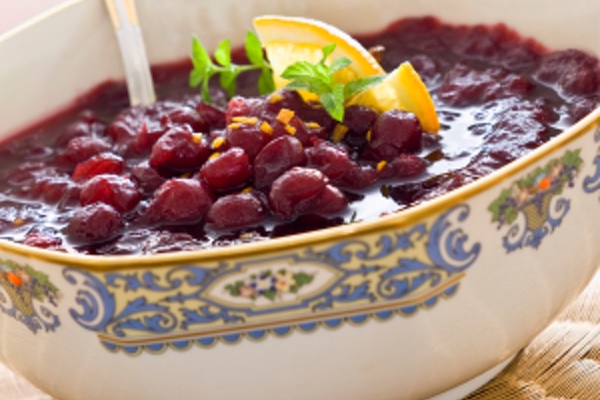
Spiced Cranberry & Orange Relish

Posted on 12 November 2009 by The Gilded Fork

Autumn rarely goes by without at least one meal that contains a freshly prepared cranberry relish. Chicken, turkey, or chops adore being dressed with this relish, and the spices will add a wonderful scent to your home as the cranberries simmer.

4 servings

Ingredients

1 pound fresh cranberries
1 1/2 cups water
5 whole cloves
5 whole allspice berries
2 cinnamon sticks
2 large navel oranges, peeled and chopped
3 cups sugar

Preparation

Place the cleaned cranberries into a 3-quart saucepan. Add the water and bring to a boil. Place the spices in a small cheesecloth bag tied with string. [Chef's Note: A coffee filter tied with string can also be used.] Add the spice package to the cranberries and simmer over medium heat until the cranberries pop, about 10 minutes.

Remove the cranberries from the heat and remove the spice package. Stir in the sugar and chopped oranges. Place in a container and chill in the refrigerator for at least 4 hours or overnight.

Service

Serve cold with your favorite meats or fish.

Recipe by Lia Soscia

Tags: , , , , ,

Comments (0)


Site hosting provided by fooMG